
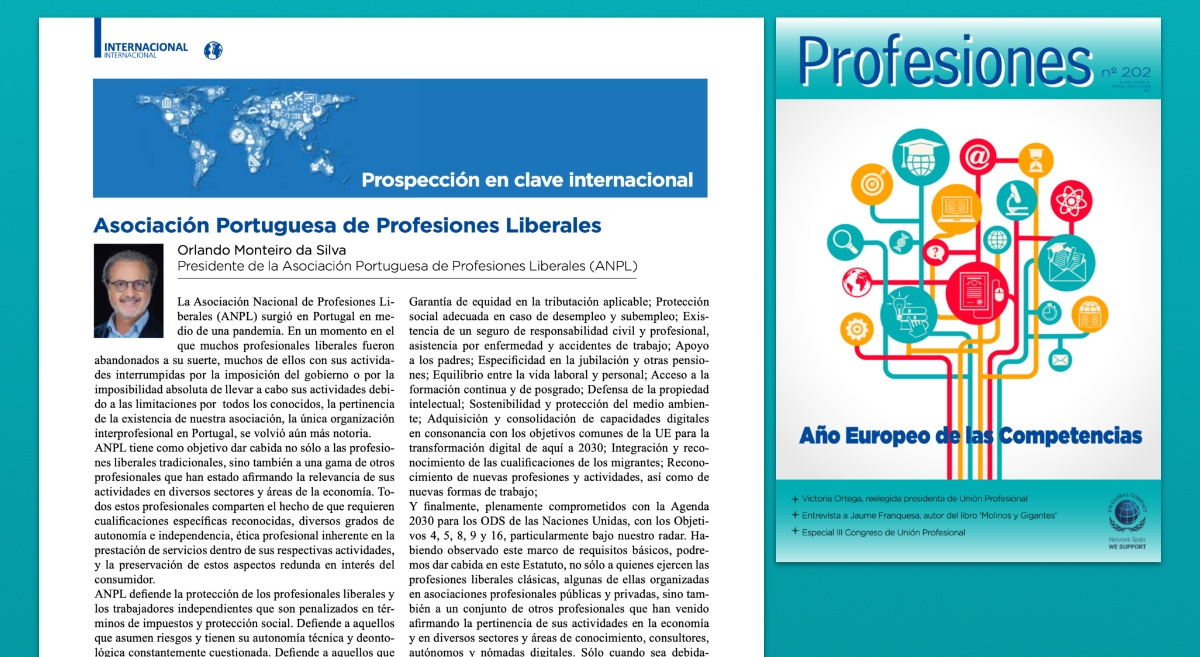
You may be interested in the article published in the latest edition of Unión Professional about an approach the future by the Portuguese liberal professionals in light of the lessons learned from the pandemic and with the horizon set by both the United Nations Agenda 2030 for Sustainable Development and the European and global priorities: environment, digitalization and rights. The text is signed by the president of the ANPL, Orlando Monteiro da Silva.
Also described the essential characteristic of ANPL, the Portuguese Association of Liberal Professionals.
Unión Profesional (UP) is the association that brings together the regulated professions in Spain. It was created in 1980 with the aim of defending the common interests of the professions and achieving coordinated functions for the benefit of society. UP encompasses the legal, economic, healthcare, social, scientific, teaching, architectural, and engineering sectors.
As a result of this interdisciplinary nature, it serves as the spokesperson and forum for reflection, debate, and opinion on all matters related to professional associations and their structures, as well as the practice of the professions.
Currently, it is composed of 35 General and Higher Councils and national professional associations, which together represent over 1,200 professional associations and territorial branches, with 1,500,000 registered professionals throughout Spain.
Unión Profesional from Spain and the Portuguese Association of Liberal Professionals
ANPL emerged in the middle of a pandemic. At a time when many liberal professionals were abandoned to their fate, many of them with their activities interrupted by government imposition or the absolute impossibility of carrying out their activities due to the constraints of all known. The pertinence of the existence of our association, the only interprofessional organization in Portugal, became even more notorious.
A ANPL aims to accommodate not only the traditional liberal professions, but also a range of other professionals who have been asserting the relevance of their activities in various sectors and areas of the economy. These professionals include Data Protection Officers, Business Consultants, Computer Programmers, Fitness Instructors, Chefs, Designers, in addition to more traditional professions such as Journalists, Teachers, Writers, Gallerists, Specialized Translators, Antique Dealers, among others, who despite having long been engaged in activities that fall within the category of liberal professions, are not recognized as such.
There are also other professional groups, such as paramedics, diagnostic and therapeutic technicians, and non-conventional therapy practitioners, who also fall within this vast and diversified field of liberal professions. All of these professionals share the fact that they require recognized specific qualifications, varying degrees of autonomy and independence, inherent professional ethics in the provision of services within their respective activities, and the preservation of these aspects is in the interest of the consumer.
ANPL stands up for the defense of liberal professionals and independent workers who are penalized in terms of taxation and social protection. It stands up for those who take risks and have their technical and deontological autonomy constantly questioned. It stands up for those who cannot be victims of work accidents or fall ill, those who do not have access to paternity protection or the ability to become unemployed. It stands up for those who have to bear the full costs of their qualification and continuous training.

Thus, starting with the foundations, it is essential to implement the Statute of the Liberal Professional, so that around it a European and national legislative and regulatory building is consolidated allowing the integration, valorization and framing of these professionals.
A statute that recognizes in liberal and equivalent professionals a different form of practice, not only by specific training and qualifications, but above all by technical autonomy and independence, based on professional, corporate and organizations ethics, in many aspects an interdisciplinary ethics, oriented to the best interests of consumers and the community in general. A Statute that integrates and contemplates essential aspects such as, among others:
• guarantee of equity in the applicable taxation
• adequate social protection in unemployment and underemployment
• the existence of civil and professional liability insurance, illness assistance and accidents at work
• parenting support
• specificity in retirement and other pensions
• work life balance
• access to continuous and postgraduate training
• intellectual property defense
• sustainability and environmental protection
• acquisition and consolidation of digital skills accordingly with the EU common targets for digital transformation by 2030
• integration and recognition of migrant’s qualifications
• recognition of new professions and activities as well as emerging forms of work
And finally, fully committed with the 2030 Agenda for SDG’s of the United Nations, with the Goals 4, 5 , 8, 9 and 16 particularly under our radar.
Having observed this framework of basic requirements, we will be able to accommodate in this Statute, not only those who exercise the classic liberal professions, some of them organized in public and private professional associations, but also a set of other professionals who have been affirming the relevance of their activities in the economy and in various sectors and areas of knowledge, consultants, freelancers and digital nomads.
Only when properly heard and recognized, will it help to mitigate the tendency of proletarianization and remunerative degradation of these professionals and their consequences, such as the affectation of the quality in the provision of the respective services as freelancers as well in companies and organizations.
The pdf version of the “Profesiones” publication is also below.
 Associação Nacional dos Profissionais Liberais